UWF professor receives national award for empowering economically disadvantaged students
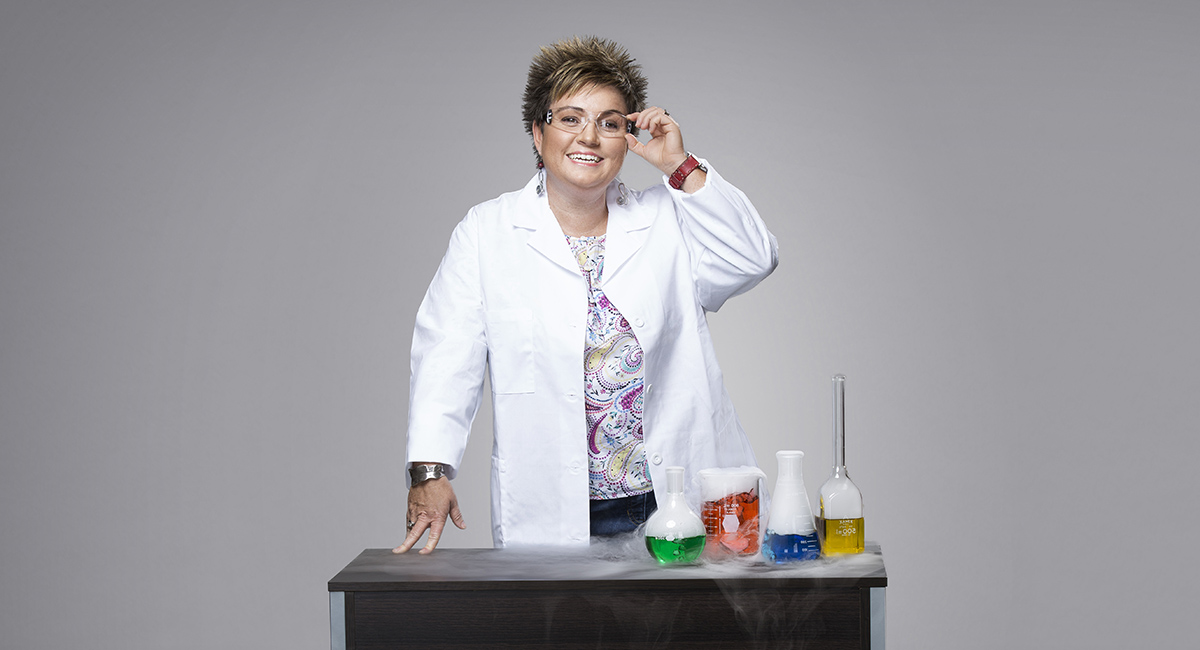
The University of West Florida’s Professor of Chemistry and Associate Vice President of Computational Intelligence and Student Scholar Programs Dr. Karen Molek has received a national award from the American Chemical Society for Encouraging Underrepresented and Economically Disadvantaged Students in Careers in the Chemical Sciences.
“I am deeply honored to receive this ACS Award,” Molek said. “This recognition reflects my lifelong commitment to supporting undergraduate students and collaborating with leadership, faculty and staff to build programs that help students thrive. Our students are highly capable, yet many face financial barriers that can prevent them from earning their degrees. Students cannot focus on learning when they are uncertain about how they will afford their next meal or aren’t connected to readily available campus resources. Providing strategic, timely support helps reduce those barriers while strengthening students’ resilience, persistence, degree attainment, and lifelong success beyond UWF.”
Established in 1993 and sponsored by the Camille and Henry Dreyfus Foundation, the ACS-Dreyfus award recognizes significant accomplishments of individuals who stimulate students who are underrepresented in the profession and elect careers in the chemical sciences and engineering. Eligible nominees for the award may come from many different professional settings including academia, industry, government or other independent facilities. The award consists of a certificate, $5,000 to the individual and a grant of $10,000 to an eligible non-profit institution designated by the recipient.
Molek is passionate about mentoring and empowering students to achieve successful STEM careers. As the founding director of the UWF Chemistry Scholars program, she has personally mentored 74 undergraduate research students, 239 Chemistry Scholars, 34 NIH MARC Scholars, 4 NIH URISE Scholars, 25 NSF S-STEM Scholars, and more than 100 UWF STEM Scholars or STEM Living Learning Community residents. The Chemistry Scholars Program, established in 2011, laid the foundation for additional STEM-focused Scholars Programs and the STEM Living Learning Community, which have supported more than 1800 STEM students, with more than 85% from financially disadvantaged backgrounds.
“Dr. Molek was one of the first faculty who demonstrated her belief in my success by investing in my future. She was the first person who recognized my talents, strengths and obstacles that hindered me from achieving my goals,” said UWF alumna Bianca Malone ‘26. “Her support soon extended beyond encouragement to an experience that reshaped my ambitions. In 2023, she invited me to attend my first conference, after which she encouraged me to raise my expectations for my future. That week changed the trajectory of my life because she empowered me to chase a passion that no one in my family has achieved – pursuing a PhD. That pivotal experience laid the foundation for the opportunities and achievements that followed. Dr. Molek’s mentorship helped me to overcome self-doubt and opened doors for opportunities like Chemistry Scholars, UWF STEM Scholars and NIH URISE Scholars. Because of her endless support, I was accepted into my dream school, the University of Maryland Baltimore County, with an NIH G-RISE Fellowship to help support my first three years of my doctorate in analytical chemistry. There is no one more deserving of this award than Dr. Molek.”
As associate vice president of Computational Intelligence, Molek played a key role in planning The Synapse, a new state-of-the-art research facility that will allow UWF faculty, staff and students to expand their capacity for discovery, innovation and collaboration for decades to come. Molek has also led teams of faculty that secured more than $7.5 million in external grant funding. This includes more than $4 million in grant awards from the National Institutes of Health to increase the number of students from financially disadvantaged backgrounds pursuing biomedical-relevant research careers through Ph.D. or MD/Ph.D. degrees and an additional $2.7 million from the National Science Foundation to support STEM degree attainment for students from financially disadvantaged backgrounds.
After receiving her B.S. in Chemistry at Mercer University, Molek pursued a Ph.D. in Physical Chemistry at the University of Georgia. She began her teaching career at UWF in 2008 and has developed a research program spanning several areas including the development of a safety relay for high-vacuum systems; rebuilding a reflectron time-of-flight mass spectrometer for surface-assisted laser desorption/ionization (SALDI) experiments on various materials; the synthesis and characterization of transition metal oxide nanopowders; the synthesis and characterization of zinc oxide quantum dots; and the development of a physical chemistry laboratory experiment measuring the speed of sound at various temperatures using nitrocellulose.
The American Chemical Society is a global nonprofit organization that fosters research excellence, advanced education and outstanding innovation in the scientific community. The Camille and Henry Dreyfus Foundation was established to advance the science of chemistry, chemical engineering and related sciences to create a positive impact on human relations around the world. Together, these two programs support individuals such as Molek who have meaningfully contributed to the development of underrepresented students in science fields.
For more information about UWF Chemistry, visit uwf.edu/chemistry. To learn more about student engagement & scholars programs at UWF, visit uwf.edu/stemscholars.