
UWF researcher leads discovery of new killifish species
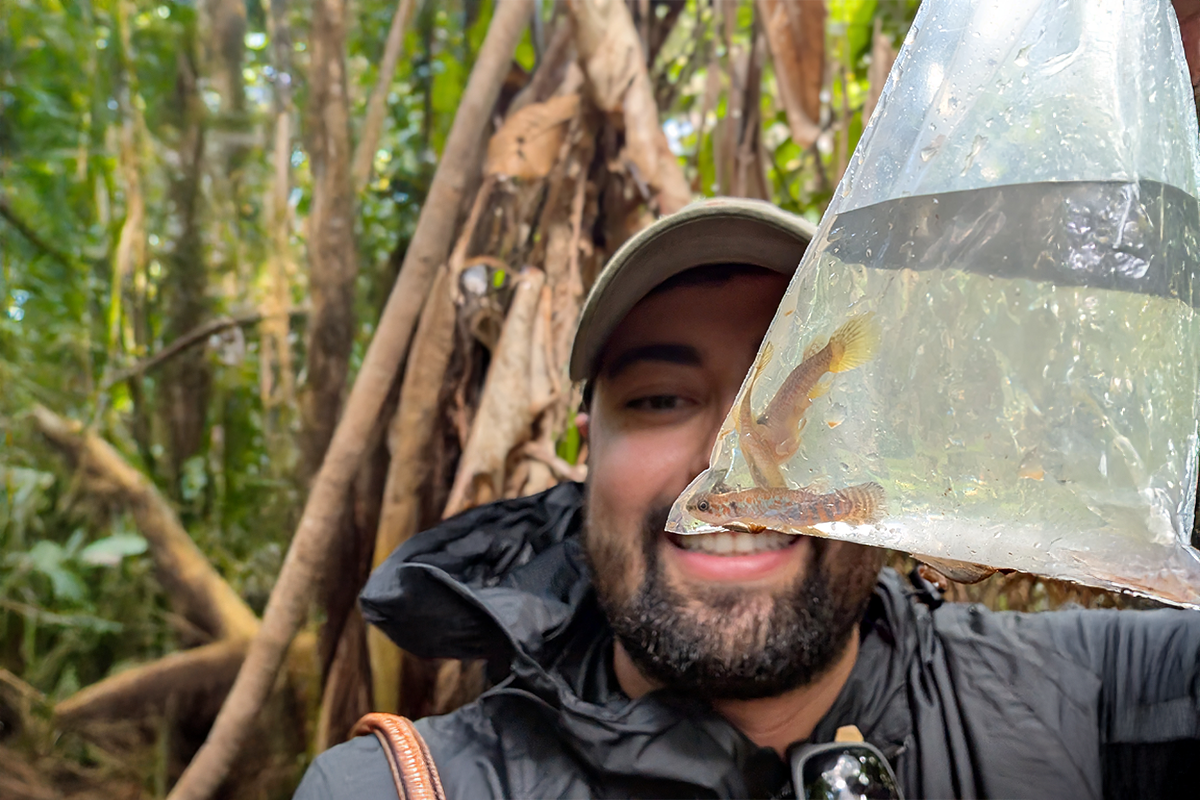
University of West Florida assistant biology professor Dr. Waldir Miron Berbel-Filho, in collaboration with three Brazilian institutions, has discovered a new species of killifish in South America. Named Laimosemion laranja, the species was identified through morphological and genetic analysis.
Berbel-Filho, along with researchers from Universidade Federal do Rio Grande do Norte, Instituto Peixe das Nuvens and Universidade Federal do Pará, found the small fish during fieldwork in tiny forest streams within the Rio Cajari drainage in Amapá, in the Brazilian Amazon. The fish measures approximately 1.18 inches and features rows of orange spots along the front of their pale gray bodies and bold orange bars near the tail. The name laranja, Portuguese for both the color orange and the fruit, reflects the fish’s distinctive and striking coloring while also honoring Laranjal do Jari, the county where it was found.
“Finding a new species is a thrilling and humbling discovery,” Berbel-Filho said. “It’s a reality check about our place on Earth and how much is still out there to be explored. And that’s the beauty of science: every new finding triggers a whole cascade of new questions.”
The species is known to inhabit an area of just 9.7 square miles across three small forest pools, leaving it vulnerable to deforestation, mining sediment and plastic pollution. The research team recommends classifying the species as endangered under International Union for Conservation of Nature guidelines and expanding a nearby reserve to protect its habitat.
Berbel-Filho’s work included collecting and documenting specimens, recording habitat characteristics and preparing samples for genetic analysis, as well as analysing the data and writing the scientific study. Researchers also compared body proportions, scale counts and skeletal features, along with mitochondrial DNA, to verify the discovery.
The discovery stems from a larger project funded by the Brazilian National Council for Scientific and Technological Development, with approximately $49,000 in total funding. The project, “Exploring the genomic and evolutionary bases underlying different life paces in killifishes,” examined how killifish have independently evolved to inhabit temporary aquatic environments, an adaptation associated with short lifespans and accelerated aging.
“This work is part of a bigger project that may help address broader questions on what molecular mechanisms lead to short lifespans and accelerated aging,” Berbel-Filho said. “These questions have implications in many fields, from aging physiology to human health and medicine.”
The international collaboration continues at UWF. Yuri Abrantes, the first author of the Laimosemion laranja study and a Ph.D. student from Brazil, recently arrived at the University to spend nine months in the MIRONlab as a visiting research scholar. Through partnerships like these, UWF faculty contribute to scientific discoveries while creating opportunities for partnerships and knowledge exchange around the world.
For more information UWF’s Department of Biology in the Hal Marcus College of Science and Engineering, visit uwf.edu/biology.
Most read in Life Science
-
Research Highlighted at UWF Student Scholars Symposium
Apr. 21, 2016 -
-