UWF President Emerita Judy Bense’s book recognized by Library of Congress
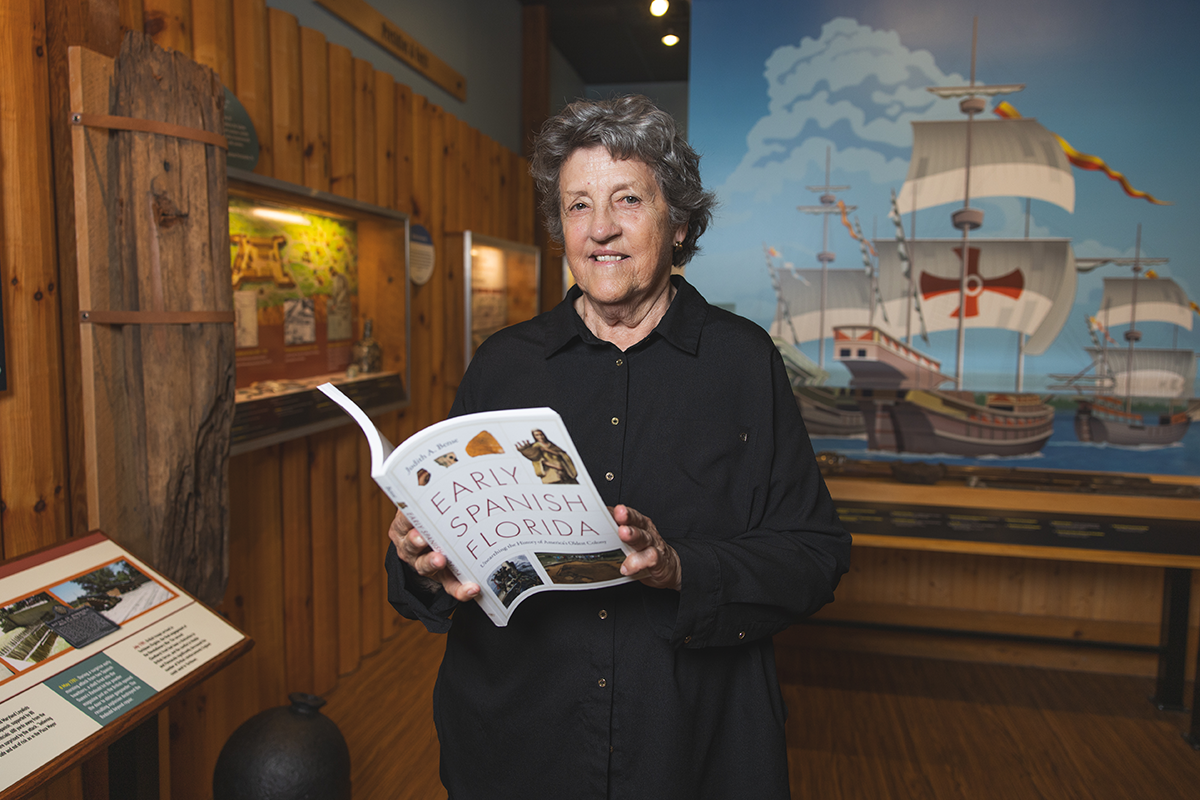
UWF President Emerita and Professor Emerita of anthropology and archaeology Dr. Judith Bense’s new book, “Early Spanish Florida: Unearthing the History of America’s Oldest Colony,” has been selected for the “Great Reads from Great Places” list for the Library of Congress’s 2026 National Book Festival.
“In one word, it feels great,” Bense said of her book’s selection. “Writing and sharing archaeology is one of our responsibilities as an archaeologist. I worked hard on writing this book for the public, and it’s satisfying to know it seems like I got it right.”
Taking place on Saturday, Aug. 22, at the Walter E. Washington Convention Center in Washington, D.C., this year’s festival theme, “America 250: It’s Your Story,” celebrates the nation’s semiquincentennial and features expanded programming marking America’s 250th anniversary. As America commemorates its 250th anniversary, Pensacola’s own colonial history offers a unique Gulf Coast perspective on the people, places and events that helped shape the nation’s earliest story.
In “Early Spanish Florida,” Bense draws on decades of archaeological research to trace Florida’s 250-year history as a Spanish colony, from Juan Ponce de León’s arrival in 1513 through Spain’s transfer of Florida to Great Britain in 1763. Through archaeological discoveries, historical records and cultural artifacts, the book explores the interactions among Spanish, Indigenous and African communities that shaped Florida’s earliest colonial history.
“This book holds many surprises for people,” Bense shared. “Most people don’t realize that for more than 200 years, Pensacola was Spanish Florida. The Spanish were in Florida two generations before Jamestown. People don’t generally know that because the focus is usually on the British part of history. People don’t always realize the Spanish story is such a major part of America’s early history.”
Having written numerous archaeology books in an academic context, Bense wanted this latest one to be written for the general public. Thanks to a generous grant from Florida Humanities with funds from the National Endowment for the Humanities, Bense was able to commission 150 colorful illustrations to accompany her writing, bringing history to life on the pages while also keeping the book affordable for everyday readers.
Bense joined the University of West Florida in 1980 and built the University’s anthropology and archaeology program from scratch. Today, the program is recognized as one of the leading archaeology programs in Florida and the nation, known for its active research and public outreach. Although retired from teaching and the presidency, Bense continues to champion UWF through philanthropic leadership and advocacy for archaeology initiatives and athletics, most recently spearheading the Division I Run Committee.
To learn more about UWF Archaeology and Anthropology, visit uwf.edu/AnthroArch.
Most read in Arts and Humanities
-

-
Research Highlighted at UWF Student Scholars Symposium
Apr. 21, 2016 -