UWF breaks ground on new research building, The Synapse
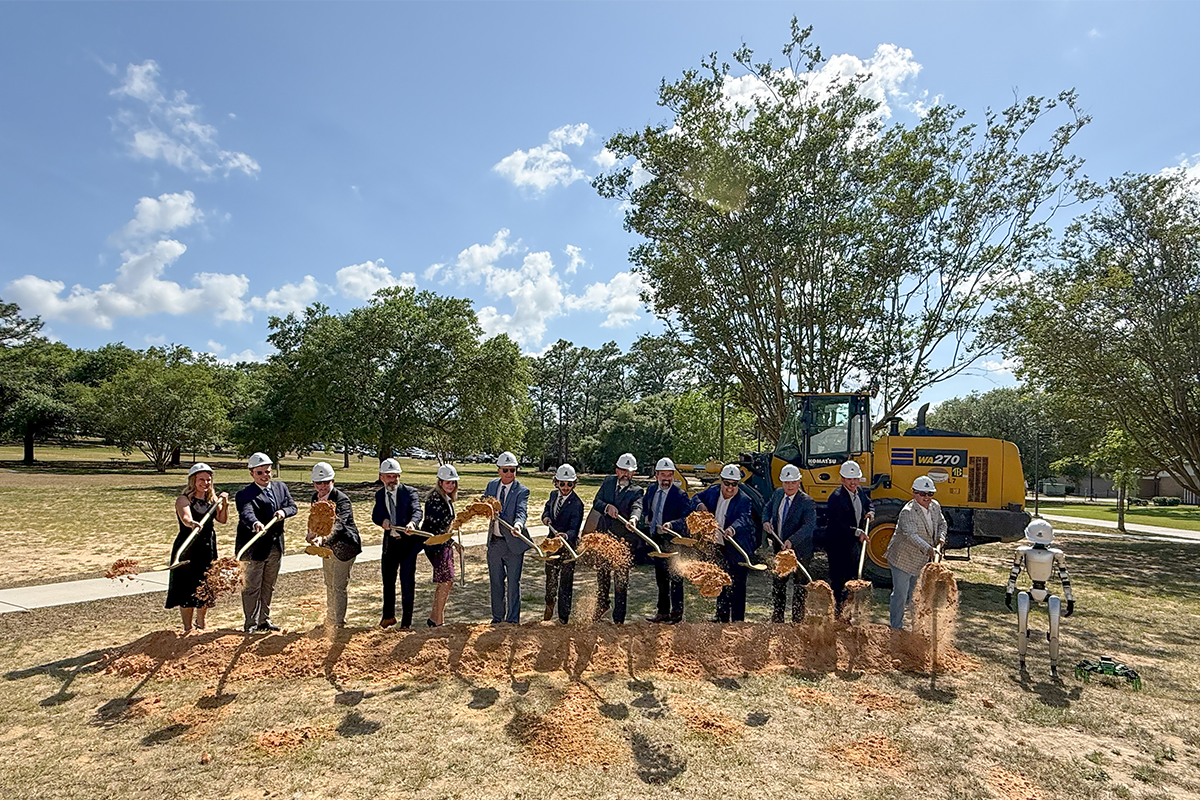
On April 23, the University of West Florida officially broke ground on a new advanced intelligence, cybersecurity and engineering research building called The Synapse. Funded by part of a $32.5 million award from Triumph Gulf Coast and more than $21 million in state funding, the 55,000-square-foot building on the Pensacola campus will house specialized labs and state-of-the-art equipment and technology to support advanced computational, AI, cybersecurity and engineering research across the University.
University leaders, faculty, staff, students, donors, community partners and elected officials gathered on campus to celebrate the beginning of construction on the new building, which will be located just south of the John C. Pace Library and identified as Building 129.
“The Synapse is a transformational facility made possible through the support of Triumph Gulf Coast and the state of Florida,” said UWF President Manny Diaz Jr. “This new modern facility will allow the University to expand research capacity, strengthen industry partnerships and better prepare students for career fields critical to our region’s future.”
The new building, designed by Caldwell Architects, is intentionally shaped like a Y to reflect its core design inspiration, the way neurons connect within the human brain. Just as synapses transmit information between neurons, the building is designed to foster collaboration and innovation across disciplines. Inspired by neuromorphic architecture – a strategy that mimics how the brain processes and stores information – The Synapse integrates research labs, office hubs and open collaboration spaces to encourage parallel discovery and the free exchange of ideas.
“The Synapse is intentionally designed to bring researchers and students together in ways that spark innovation,” said UWF Provost Jaromy Kuhl. “By connecting disciplines and creating shared spaces for discovery, this facility will accelerate research and expand opportunities for experiential learning.”
The facility will serve as the base for the Center for Computational Intelligence and the Center for Cybersecurity and AI, as well as a hub for collaborative projects in robotics, artificial intelligence, cybersecurity, power systems, material science and civil engineering. A central multi-story atrium with interconnected corridors create efficient pathways for interaction, resulting in a facility built not only for cutting-edge technology, but for constant intellectual connection.
“The new building will support the type of interactions its namesake implies,” said Dr. Mohamed Khabou, dean of the Hal Marcus College of Science and Engineering. “Ideas from various research areas come together to excite other research pathways.”
The Center for Computational Intelligence, housed within UWF’s Institute for Analytics and Industry Advancement, serves as a world-class hub for advanced computational research, uniting faculty, researchers, students and industry partners around the development of next-generation technologies. With its new home in the Synapse, the CCI will be able to design and apply computational models and systems capable of performing complex tasks to accelerate innovations with direct applications in healthcare, applied and basic sciences, engineering, energy, environmental monitoring, personalized education and defense.
“This dynamic new research hub will position UWF to expand its cutting-edge computational research, creating opportunities to tackle complex, real-world challenges across diverse fields through collaborations on campus and with external partners,” said Karen Molek, associate vice president of Computational Intelligence and Student Scholars Programs.
Upon completion of the new building, the UWF Center for Cybersecurity and AI will join CCI in the Synapse. The UWF Center for Cybersecurity and AI is a globally recognized leader in advancing secure, responsible digital and intelligent systems and preparing workforce-ready AI and cybersecurity leaders.
“The Synapse represents the future of innovation, where AI, cybersecurity and advanced computing come together to solve complex challenges,” said Dr. Eman El-Sheikh, associate vice president of the UWF Center for Cybersecurity and AI. “This state-of-the-art environment will accelerate research, strengthen collaboration and position UWF as a leader in securing and advancing intelligent systems.”
For more information about the UWF Center for Computational Intelligence, visit uwf.edu/cci. For more information about the UWF Center for Cybersecurity and AI, visit uwf.edu/cyberai. For more information about the Hal Marcus College of Science and Engineering, visit uwf.edu/hmcse.